Showing posts with label research. Show all posts

13/03/2017

Chloe Dewe Mathews: Shot at Dawn


Chloe Dewe Matthews is a British documentary photographer whose work I came across online a few weeks ago. I took a particular interest in her Shot at Dawn series as she presents her subject matter of something that has happened in the past in the kind of way I would like to present my subejct matter of hauntings for my self directed assignment. 

Shot at Dawn is a body of work consisting of twenty three images that show locations at which British, French and Belgian soldiers were executed between 1914 and 1918 for cowardice and desertion. The photographs were taken as close to the exact time of day and year as the actual executions in each location as possible, and as most executions took place at dawn this provided Dewe Matthews with the title of the series. 

Due to the images being shot so early in the morning there is a really fitting eeriness given to the sites in the photographs which today look to be very ordinary unassuming places. There is a real potency to these landscape photographs in looking at these today forgotten sites as they raise awareness of a subject matter that is very often neglected when discussing the first world war. These hundreds of soldiers shot by their own side were often teenage volunteers who had signed up to fight in a war they really couldn’t have anticipated the severity of. These haunting photographs provide a moving memorial of the fate of these people. 

Dewe Matthews puts us very much in her shoes as a photographer in arriving somewhere a hundred years after an event has happened. In witnessing the landscape that has witnessed this event we are able to see exactly what these soldiers saw the day of their execution. There is something incredibly moving about being able to put yourself in their shoes in this way, knowing that they were just young people who could no longer cope in one of the most horrific wars. To me this series seeks to give us a connection to an event that happened a century ago, to be aware of the relationship we have with our landscape and to not assume we have an innocence towards it. 

This series also seeks to question the British national conscience in how we feel about how the British army chose to discipline soldiers in this way which has been rather ignored in contrast to what happened on the front lines. At the time of their execution these people were branded as degenerates who were best forgotten, and now there is a real feeling of unease in how death did not meet them abruptly on the battlefield and instead from the people leading them who were on their side. We are also now aware that at least some of the soldiers will have been suffering from mental illnesses caused by the warfare. Which there wasn’t recognition or understanding of at that time and that if they had acted like that today they would be treated very differently. 


The captioning for this series I feel is what gives it such potency as these calm figureless landscape photographs are met with a chilling record of the location, time, date and names of people killed on that morning of an execution that took place in that location. The subject matter for this series is so serious and as a British person it is really haunting to know that British soldiers around my age were treated like this just for not being able to cope in such a horrible war. 

The way these landscapes are so empty and many are overgrown really communicates that this is something that the countries involved would rather forget. And that killing these people didn't achieve anything. 

In terms of my own less literal subject matter, looking at this series has made me think more about how I can capture in some way an element of the event that apparently has happened in each of the my locations I will be photographing. As in Dewe Matthews' project she has captured the time of day they occurred at as well, which will be difficult for me as I am unable to drive to the places I want to photograph. Instead I think taking all the photographs at the same time of day may give it a better consistency that I am looking for. I don't want to make too many aesthetic decisions that will overcomplicate how people read the subject matter but I definitely don't want to take the photographs at night. I think that taking my photographs around midday will give my subject matter clarity in a way that does not look at though I am trying to add anything to it. 

Amy Romer: The Dark Figure


British documentary photographer Amy Romer's latest body of work is a project that explores modern slavery in the UK. I took a real interest in this series after she gave a guest lecture to us a month or so ago. As like the photographs I have been taking an interest in by other photographers in my research, she does not show her subject matter for this series in a literal way and instead photographs the places where these events occur. 

Her series is called The Dark Figure which refers to the estimation that there are 13,000 slaves in the UK today by the Home Office. In this series Romer has visited and photographed locations where cases of modern slavery have been reported. These square landscape photographs with their haunting captions detailing cases of modern slavery creates an incredibly powerful series that makes you realise that these horrible crimes are happening a lot closer to home then you think. 

What is particularly stirring about these photographs for a person who is from the UK to view is that all these places either are or look so familiar to us. The architecture and landscape in the UK does not vary that much so there is a real sense of emotional conflict for a viewer in viewing something so stirring that aesthetically presents us with the suburbs and landscapes we see all the time and yet these horrible things are happening or have happened within them. 


These photographs like some of the other documentary images I have looked at so far feel very quiet, almost to suggest the lack of witnesses or how we ignore and don't focus on these sinister things happening under our noses. The silence created by the lack of people in these photographs makes you question how safe we actually are and it really makes you consider how we view these seemingly ordinary places. 

This project isn't as quiet as it seems however and once you begin to read the captions whist looking at the photographs the series grows more insistent in making you aware that human trafficking isn't limited to a type of person or industry and that this problem exists everywhere. It makes you question why individually we are ignorant of this problem, which makes for an incredibly evocative series and really makes you confront and except that this problem exists. 

In terms of how looking this series can influence my own work it has really shown me just how powerful captioning can be and looking at the ways the photographers I have looked at have captioned their images is something I have been taking a lot of note of. In Romer's work I really like that the date of the event is put first which I think is something that makes these images really impactful because it makes you realise just how much of a contemporary issue modern slavery is.

I am now almost certain that I will shoot colour film for my SDA project and focus on landscapes as I love the effect of the inexplicit images I have been looking at, where the subject matter is left to be discovered fully in the captioning of the photograph. I also love the richness of colour and texture of colour film which I have never used before so I think this project will be a great chance to try it out over a longer period of time. Which I think will allow me to link well the different stories of hauntings I would like to capture. 

Mark Power: The Shipping Forecast


The next photographer I have looked at as part of my research for my self directed project is Mark Power and in particular I took an interest in his Shipping Forecast series of photographs, which were published in a photo book of the same title in 1996. This series of black and white film photographs are taken of the 31 places along the UK coastline that the BBC shipping forecast covers. Power's photographs of beaches and coastal life captures postwar British life and a huge part of the culture of these places as the weather forecast affects the livelihoods of the people who live there. 

His photographs of these places are captioned with the forecast for the area on the day the photograph was taken. I have included the captions with the photographs above because they are really important to this series and is what gives context to these photographs. The forecast clearly links the people of these places to a real sense of what it is to be British, which really romanticises the British Isles. I do feel that these photographs are a really interesting series of social documentary images that communicate an aspect of British culture in a unique way.

The way power composes space in his photographs I feel communicates how much force nature has over these communities and the lack of people in the photographs also suggests the control these forecasts have, over how these people live their daily lives. The use of shadows and the way clouds are often looming in his photographs also gives a haunting quality to these images as though these moments of calm are under threat. 

Many of his landscape photographs remind me of romantic paintings with their symmetrical nature and stillness, making the viewer reflect whilst reading the caption in these silent spaces Power has created. There is something poetic about the nature of the shipping forecast and visualised with these landscapes to me makes these scenes feel spiritual. What we read about in the captions is out of human control, and instead is presented as a higher force.

In many ways my subject matter could be considered a higher force and these atmospheric images have given me a lot more to think about in how I can present subject matter of this nature. The way I photograph a place if I choose to shoot landscapes and still life will very much effect how a viewer reads and receives the caption's description of the hauntings. 

Paul Graham: Troubled Land


In exploring other documentary work which I have been doing by looking at photo books in the library, I came across Paul Graham's Troubled Land: Social Landscape of Northern Ireland. I have decided to discuss his work as his approach to his subject matter I find particularly inspiring. 

Paul Graham is a British fine art and documentary photographer. His Troubled Land series was made up of landscape and still life photographs taken in Ireland during the war. They are devoid of people and illustrate a cultural and geopolitical typography at that time. What interests me so much about this series is that they are war photographs that do not show a full frontal war as their literal subject matter. Instead they show the social landscape of communities classed as war zones. 

In his landscape photographs in particular the horizon line is usually halfway up the photograph meaning a lot of the image is made up of the sky. Which I think really adds a sense of calmness to his images as though they are giving the audience space to breath and are a token of reflection. Graham's photographs in this series are made up of layers of social meanings and really make the viewer ask questions about why he has chosen to photograph certain places and still life. Giving an introspective quality to his photographs for a viewer to experience. They merge the context of the war with this aesthetic consideration Graham has taken which makes for a really thought provoking series of images. 

I like this element in his work because I don't always think photographs should provide all the answers for a viewer or be overtly literal in their subject matter. The more metaphorical and psychological nature to Graham's work I think is what makes his photographs so interesting for a viewer. I also think the formality of how he presents his landscapes is really effective and this consistency in the horizon and leading lines etc has given me lots more to think about aesthetically in creating multiple images for a series. 

In terms of my ideas for my current project, Troubled Land has allowed me to consider further how I can present my subject matter of hauntings, which is harder to photograph literally. I am really drawn to photographing landscapes for my series to show where these stories of hauntings took place. However I need to work out the ways I can caption the photographs and provide a consistency aesthetically to them like Graham has done and the feelings that are evoked from his images. I do like the idea of my photographs being more inexplicit to focus on social experience and psychology rather then being dominated overtly in subject matter by the people who claim to have experienced these hauntings. 

21/02/2017

SDA Brief and Initial Ideas

Taking single pictures is easy. Telling a story through the intelligent edit, layout and construction of a series of images is an integral part of becoming a successful press and editorial photographer. Using your knowledge of the building blocks of editorial photography you are now being asked to complete a number of assignments with strict restrictions on the number of pictures that can be submitted for assessment and getting used to producing quality work within short deadlines. These two assignments are an opportunity to find stories and subjects you are interested in and passionate about. Through weekly tutorials and critiques you will become aware of the editing process and story construction. 

For the next brief we have been tasked with creating two sets of five picture stories. The first being a more focused five picture story and the second a self directed assignment that should sustain you throughout the semester as you explore the subject matter and how you want to photograph it. 

For my self directed project below is a list of some my current ideas for subject areas...

Arts
- Artists, studios, arts education in Cornwall
- Dance studios, circus companies

Nature/Conservation
- Gardens of Cornwall
- Conservation projects

Cornish Culture
- Producers of Cornish Food
- Fishing Industry
- Sports
- Ship Wrecking

Paranormal
- Ghosts
- UFOs
- Spiritualism

I have taken a particular interest in the more paranormal subject areas that I could explore with my work and have spent a great deal of time researching these possibilities so far. I have looked into different groups that investigate the paranormal in Cornwall and those who have claimed to have seen UFOs and it isn't taking me anywhere. I contacted the people who arrange a paranormal meet up in Truro however they told me they already have two photographers for the event. So I have decided to leave that subject matter for now.

I also like the idea of doing a project on arts organisations in Cornwall however I feel that is a subject matter I would like to dedicate a lot more time and energy to than I am able to do with this brief. The same goes for a project on local food producers in Cornwall, spiritualist churches in Cornwall and conservation projects.

Instead I want to explore finding a way to create a picture story still about the paranormal in Cornwall but instead of UFO phenomena I want to look at hauntings as I have found loads of statements about hauntings across Cornwall. I want to find a way to join different stories up to create a study of claims of paranormal sightings to investigate patterns or the kinds of places where hauntings tend to occur. To explore the psycho geography of hauntings in Cornwall. 

Vivian Maier


After watching a documentary on the life and work of Vivian Maier I have decided to look at her street photographs to inform my current thoughts and approaches to the relationship brief. Maier was a mysterious American nanny whose photographs remained undiscovered until her death in 2009. She is now considered one of the greatest photographers of the 20th century. While looking after other people's children she would take to the streets with her Rolleiflex camera at her waist to photograph the public.


One thing that is particularly evident when looking at Maier's monochrome square street photographs is how incredibly observant she was. Noticing small details in shop windows for example and dresses blowing in the wind. I love the photograph above for example because of this pattern she noticed of these men wearing their hats and reading their newspapers. There is a real sense of rhythm created through the repetition in this photograph, illustrating that people like this are the rhythm of this city. 


Maier's photographs of people are her most memorable often because of the way she interacted with her subjects. Holding her Rolleiflex at her waist she would stand and stare at her subjects which is why we see these really interesting expressions from the people in her images. Which often looks to be confrontational but there is something calm about the way her subjects react to her presence. To me it feels as though Maier used her photography to express how she felt like an outsider. It is as though she has briefly entered these people's lives to try and understand people, and herself. 

Maier also took a lot of self portraits and photographed her own shadow often. The presence of the photographer being so overtly demonstrated throughout her different photographs I find really intriguing, and it really allows you to connect to the subject matter in a different way. You aren't just seeing what is directly in front of you, you are able to understand more the photographer's place in the photograph and the relationship they have with their subject matter. 

Her approach and style often veers towards that of other great photographers such as Weegee, Robert Frank and Richard Avedon. However there is a unique sense of gentleness in her photographs which is often paired with high emotion. I think the way she is able to turn these often passing shots into such transient moments is incredibly special and is why her work has been so well received by people in the past decade since its discovery. 

Maier's approach to street photography I find so inspiring, particularly in the way she considers her own position in taking the photograph. I feel that despite capturing other people she is capturing a part of herself and what fascinates her. Her eye for design and composition in her images is also a strong element of her photographs, some of her images even seem like editorial fashion shots despite being candid photographs. This approach that creates such clean and beautiful photographs that are so atmospheric is really inspiring to me and I feel I need to go out more and just work on taking candid photographs with film, just to get a feel for this kind of photography. 

Andre Kertesz


“André Kertész has two qualities that are essential for a great photographer: an insatiable curiosity about the world, about people, and about life, and a precise sense of form.” – Brassai
The next photographer I have decided to look at is Andre Kertesz as I came across his work in a book the other day and was left feeling really inspired by his style of photojournalism. Kertesz was a Hungarian photographer who is best known for pioneering what we now know as candid photography. 

What made Kerteszs' photoessays so unique was the simplicity and abstract nature of his photographs, that were taken either close up or far away to isolate subjects. His photographs of the backs of or small details of people in the streets of Hungary and Paris show a disinterest he had in cities, unlike many other photographers. His images show us that he sought to show typical moments of people in the cultures he photographed. 

This particular aspect of his work has made me think more about how to record occurrences and moments in relationships in different ways. As Kerteszs' photographs often look more graphical and abstract. The relationships captured often form the entire composition, giving a very psychological and subjective aspect to his work. His images are deceptively simple however; I read that the Editors of Life told him that his 'pictures talk too much.' This refers to how symbolic his photographs are and the messages of which are clearly well thought out. Yet his photographs are so ambiguous leaving you wondering what exactly is happening inside and outside of the frame and often asking questions about the ways people interact with one another.


“Seeing is not enough; you have to feel what you photograph”
– Andre Kertesz
Kerteszs' photographs often bring a viewer in uncomfortably close. The photograph above for example of the woman with a hand on her shoulder is incredibly close up, making us think very much about this possessive gesture; possibly from her male partner. The anonymity of this other person makes this a rather haunting photograph yet this is a very quintessential action. It is the composition of this photograph that changes completely how we respond to this moment between these two people. 

To me his photographs are about the holding a mirror up to every elements of the human experience allowing us to observe them closely. His work feels like a unique mix of documentary and abstract photography that allows us to view other people's lives in an introspective manner. The way he photographs people shows a real sensitivity he had as a photographer, as through disarming his subjects they often feel familiar to us.

Looking at Kerteszs' work has really allowed me to see just how broad documentary photography and photojournalism can be in its presentation. Kertesz captured human relationships in a very different manner to the other photographers I have looked at so far however his photographs say just as much about people and how they interact with one another. 

Marc Riboud

Anshan (China), 1957
London, 1954
"I am not either a war photographer or news photographer.. I have always been more sensitive to the beauty of the world than to its violence and monsters."

I came across the work of French photojournalist Marc Riboud in the book A-Z of Photographers by Michael Koetzle, which I often sift through when looking for inspiration for my photography work. His work grabbed my interest in particular when I came across his photographs in The Concerned Photographer (1968), edited by Cornell Capa. Which is a collection of photographs showing post war crisis from 8 of the most prominent photojournalists at that time, including Don McCullin, Bruce Davidson and Marc Riboud. Riboud's photographs were taken in Eastern Asia in countries such as China and Vietnam, and show a real compassion and desire to show the human struggle. As many of his images sensitively captured manual labourers and working class families, in places that had just been through periods of war and violence.

What interests me about these particular photographs of Riboud's that are shown in The Concerned Photographer is the more humanist approach he took in representing these areas experiencing periods of war and violence. I like that his approach to photojournalism steered away from the more gritty war photography and instead focused on communities and cultures. As this is a perspective that reveals even more about the violence in my opinion in terms of the wider context that these situations have occurred in. 


"To understand and appreciate Riboud's aims, one need only to review the subjects he has chosen to photograph. Once examined, a definite pattern takes shape indicating that here is a man who is concerned with people, their unique portion of the earth, and their continually intense interaction upon each other." - Charles R. Reynolds, Jr. 

In Marc Riboud (Photofile) he talks about what he refers to as the pleasures of seeing. That he feels a "double tension" in taking photographs; "the fear of destroying an intimacy by approaching it and at the same time the strong desire to photograph as close as possible". By this he is referring to the appeal of photographing something up close that you wouldn't dare stare at and when looking at his street photography it is very clear what Riboud is referring to. He seems to have a curiosity for intimate moments yet captured them in a removed way and doesn't interact with the subject while photographing them.

His photographs reveal to us a modest approach to photography and a constant searching of truth, stories and intellect in his subjects.


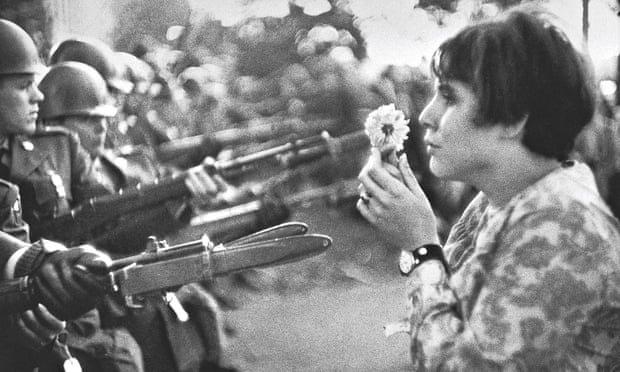
One of my favourite photographs of Riboud's is Young Girl With a Flower which shows seventeen year old Jan Rose Kasmir holding a chrysanthemum up to a soldier’s rifle bayonet. At the Pentagon in Washington D.C on October 21st, 1967; the location for one of the most influential demonstrations against the war that was taking place in Vietnam. Not for its crowds or levels of violence but because of the impact it had on the American population and government’s perspective on their involvement in the Vietnam war. What I think is so potent about this photograph is the tenderness that we get from young Kasmir who appears to be pleading with these soldiers of a similar age to her. 

This image shows the determination Riboud had for finding Bresson's decisive moment. The emotion and symbolism captured in this image is so telling of the circumstances at this time and to see such a young girl standing up for what she believes in is incredibly powerful. We see Kasmir’s flower, a symbol of peace and innocence being put at a knife’s edge across a bayonet. This could be said to represent what America was doing to its own people in Vietnam and the lives at stake over the entire conflict. The watch on Kasmir’s wrist could also symbolise mortality being threatened by the control of forces, and that time is so fleeting when human lives are on the line. For Riboud to get so close to this moment and yet still manage to capture it in such an intimate way without interrupting it shows a real skill Riboud had as a photographer in terms of the presence he made around people.

France, 1987

Houston (USA), 1987

Istanbul, 1998
Villeurbanne, 1984
Looking at Riboud's work has made me think a lot more about my presence as a photographer when taking candid and street photography. It's clear that you need to spend a lot of time with your subjects but also be quite removed. They need to feel comfortable enough around you that they don't notice you. Something that can be difficult when doing street photography for example as if your presence seems overly cautious or malicious that is when people will begin to feel uncomfortable and notice you more. I don't think this kind of photography should be voyeuristic however and I would really like to build my confidence in taking photographs of the general public. 

I'm still not sure about my relationship photographs. Events photography is really appealing to me because I can be removed from my subjects in order to capture candid moments showing relationships and people also wouldn't take issue with me being there. I do events photography for AMATA so I may try and find a way to do a project on maybe certain kinds of events or an element of events that interests me.