Showing posts with label sda. Show all posts

21/03/2017

SDA Shoot 4 + 5: St Ives & Kennel Vale

As I scanned my negatives for these two shoots at the same time I thought I would discuss my final two SDA shoots together. For the first shoot I went to St Ives to photograph Porthminster beach and for the second I went over to Kennel Vale in Posanooth.


Although it was a cloudy day which was ideal I really struggled to photograph the beach. However in the end I am most pleased with this very simple shot above that has this haziness in the background. I said I didn't want to make my photographs look overly spooky but this is just the weather especially at this time of year in Cornwall, and I like that the shot is very forward facing and you have this leading line taking you into the water and eventually this hazy horizon.


Kennel Vale I found a really difficult shoot because there are so many little buildings that remain of the gun powder works and I really wasn't sure where to start or what would look best. Which is why I have so many different photographs of this location to choose from. After discussing these photographs with Mal I have come to like the photograph above best. As I think this really shows what people are familiar with of this place and has a sense of intrigue about it that I have similarly created in my chosen photographs from other shoots.  

13/03/2017

SDA Shoot 3: Bodmin Jail + Lanhydrock House

For my next shoot I planned to visit two places in Bodmin. The first being Bodmin Jail; built in the late 18th century and a hot spot for hangings, the jail has an abundance of haunting stories and reports of deceased prisoners returning to haunt the jail. The second location I visited was Lanhydrock house; a stately home supposedly haunted by a grey lady who haunts the only two rooms that remained after a fire, and also a man who was hanged by royalists during the Civil War. 


Photographing Bodmin Jail was initially a struggle as there is a lot of building work happening on the exterior which I obviously did not want to photograph. Eventually I found a route to walk around the outside on the jail that led me to this view looking up into the old cells. It was difficult because I had to photograph through a big gate but I think I got a nice variety of shots. My only concern is that there isn't as much distance between me and the subject as I want to maintain in this series. But I will have to see how these photographs look with my other shots. The photograph above is one of my personal favourites because of the way these leading lines lead somewhere that appears hazy and I also like the detail to begin with of the overgrown ivy on the walls. 


The photograph above is my favourite that I took of Lanhydrock house because there is a mysterious feeling to it created by this distance and I like the symmetry and the tilting of the trees in the frame. I am not so keen on my closer shots of the building because I feel that they show too much of the newer parts of the building and also signposts and fencing etc that has been put there by the National Trust. 

Overall I am pretty pleased with my photographs from this shoot and I definitely want to use the Lanhydrock photograph. I am definitely getting more comfortable with shooting this kind of film and using the Minnolta camera so will feel much more confident using it for my next shoot for this project.

SDA Shoot 2: Penryn, Penmere Railway Station + Pendennis

For my second SDA shoot I decided to commit to colour film in the form of Fujifilm SUPERIA X-TRA 400 and have decided to use the Minnolta again with the 24mm lens as I really liked the landscape shots I took with it for my five picture story and the expanse and distance it creates between the photographer and subject matter in photographs. As I want there to be a feeling of distance as the actually subject matter is not so much the places but their stories. 


The first place I visited was Pendennis Castle in Falmouth which is said to be haunted by a screaming kitchen maid who can be heard in the basement. I did consider photographing the basement however this shot really wouldn't have informed the viewer that it is a Cornish location which I would like it to. In the end I am most happy with the exterior shot of the circular castle above. As I think there is something rather sinister about this cold looking building sat on top of this hill. I had to wait a while for people to move out of the shot but I think it was worth it. I did take this just after midday but it was cloudy which I don't mind as much as it's given the building and grass more texture. 

For my second location I revisited Penmere train station and this time I am much happier with my shots. In the end I prefer this shot above as I like the victorian looking sign as it references the haunting which is supposedly the spirit of a victorian girl who walks the platform. I also like this leading line creates by the railway which gives this small station much more expanse.

My favourite photograph from this shoot is this photograph of St Gluvias church in Penryn. I decided to take this shot from further away in order to focus more on the bell tower which the spirit of a captain that supposedly haunts this location is said to on occasion ring the bells here at early hours in the morning. I also took this photograph from further away so that when you do read the caption you can almost imagine the bells echoing down this graveyard.


Finally on this long day shoot I took some photographs of the streets of Penryn. As during the Christmas festive period there is said to be a spirit who rides a horse and carriage down the streets and disappears. I was really just experimenting with this subject matter but I definitely won't be using these shots as I want my series to be made up of more well known and visited locations that people who know Cornwall are more familiar with visually. 

SDA Shoot 1: Penmere Railway Station

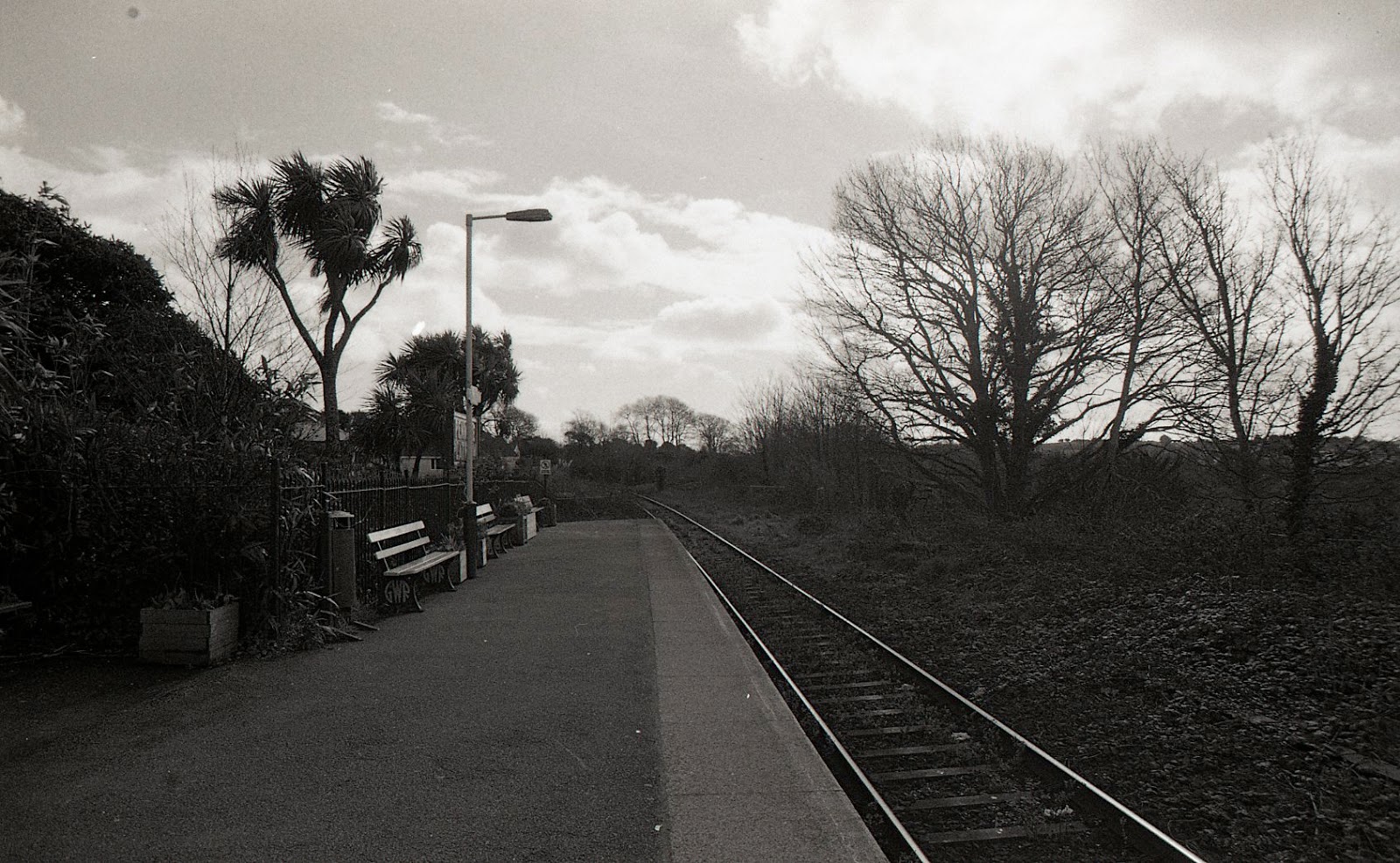
To begin experimenting with 35mm film for my SDA subject matter I decided to try using some Ilford HP5 to photograph Penmere station. I chose Penmere train station because I read on a paranormal database online the story of the spirit of a victorian girl who has been seen to walk the platform. As it is close to campus I thought this would be a good place to start with playing around with different kinds of film, lenses and compositions. I used a 50mm lens on my Olympus OM10 for these shots and although I really like the first photograph of the shelter I think there is something missing in terms of atmosphere from these photographs. 

I think using this black and white film has just confirmed to me that I won't be using it to shoot this self directed assignment work. As I want there to be more a sense of familiarity to my images for people as well as a strange feeling, and I think they need to see these places in colour in order to feel this. 

I also want to try taking my photographs with a wider lens like I did for my Predannack photographs. As I really liked how expansive the images were and they let you see something more similar to how you would with your own eyes. As the human eye's focal length is around 17mm.


Edward Thompson: The Village


As most of my research so far has led me towards documentary projects that use landscapes to tell different stories, I decided to look for a project that has a haunted subject matter similar to the kind of subject matter I will be exploring with my SDA work. This led me to Edward Thompson’s The Village.

Edward Thompson is a British documentary photographer and his The Village series is part of a larger body of work that makes up the content for his The Unseen book. In which all the series of images in the book were photographed using the last 52 rolls of Kodak Aerochrome Infrared film in locations across the world. Thompson used this to capture subject matters that are said to contain things that infrared film could possibly capture such as drought and radiation. 

The Village became a project for Thompson when he learnt that the village of Pluckley in Kent is the most haunted village in the U.K and that infrared film could possibly capture the kinds of apparitions that were said to haunt this village. What is interesting about this series of landscapes of this village is that even though we do not see any apparitions in the images themselves the blood red foliage created by the colour shift of infrared film is particularly sinister in itself. It changes the green landscape we know of British rural areas into a sea of red texture. 

These landscape photographs provide a surreal view of rural Kent. Referred to as the garden of England the infrared film juxtaposes this by showing us a very sinister version of this place. The images look so otherworldly as though they are from science fiction stories such as H.G Wells War of the Worlds. 

What interests me about the use of infrared film to photograph these landscapes is the way it makes you question the subject matter. Knowing that this is supposedly the most haunted place in Britain, having Pluckley presented in this way makes us question the boundaries of our own senses, and whether there are things we do not notice due to boundaries in how much we can perceive in the landscapes surrounding us. 

The photograph of a horse shown above refers to one of the stories of hauntings about a tale of a phantom horse and coach passing through the village. This photograph shows just how powerful this infrared film is in making such an innocent subject matter appear so menacing. I think this aesthetic decision by Thompson is really powerful especially in the way it looks to be so natural of the landscape in this photograph. Although no actual ghosts were revealed through the film the calmness of these landscapes juxtaposed with the brooding feel of this deep blood like red, suggests very much the context of these landscapes. I cannot find captioning for this series and do not have access to The Unseen book therefore I do not know if captions are use to extend the meaning of these photographs. However I do think the use of infrared film alone is powerful enough in making the subject matter of these landscapes clear for a viewer.  

Looking at this series has made me consider more about what I can illustrate as a documentary photographer in revisiting places where a story has already been said to have occurred. I am not intending to go to these places to photograph ghosts therefore thinking about representing these places has been the biggest decision for me and is something I now need to experiment with. Which I will do by visiting some of these locations and experimenting with different film, lenses and other ways I can approach photographing these places. 

Joel Sternfeld: On This Site


"Mr Sternfeld had devised a Baedeker to America in the age of anxiety, fear and moral crisis. One could argue that American life has been shaped by the events that took place on these largely unsung spots which form a contour map of contemporary angst." - Vicki Goldberg, The New York Times, February 13, 1994
After a tutorial with Lottie to discuss my my current SDA idea she suggested I look at Joel Sternfeld's On This Site for inspiration. Joel Sternfeld is an American fine art and documentary photographer. On This Site is a series of fifty photographs that Sternfeld took of fifty infamous crime scenes in the United States. The series captures these places where violence has stained the American landscape and looks at what has been left behind in these ordinary looking places.

The fifty photographs in this series were published in a photo book of the same name and inside the book you can view the full captions that go with each photograph. Which are created from reportage from newspapers and magazines that describe the crime that took place there. The photographs by themselves taken of these landscapes are devoid of people and rather unadorned however once you read the brief text that goes alongside these images there is a surprising potency that is created by them.

The captions really allow the viewer to take a step back and contemplate these events. This makes this series of images very much like memorials of what has happened in these places and I imagine for an American (like a British person looking at Amy Romer's work) that the work makes them question their sense of national identity. As decades of violence has shaped the American landscape yet there is a real irresponsibility towards this kind of violence in the United States.


Photographs such as the one above of the grocery in Missisipi show you places devoid of people that look to now have a calmness to them. They are taken in a very formal way presenting these places to us as though we are passing them on the street. It is only once you start to read the captioning that the perception we have of these places is changed for the viewer. Naturally we seem to assume innocence of the landscape yet in this series we are asked to stand between the threshold of what has happened there and what now remains in these places.

Individually these photographs have a potency with their accompanied text however as a series they become much more powerful. As you begin to acknowledge the crimes that have occurred in these places. There is certainly a familiarity for a viewer when looking at photographs presented in this way (particularly for an American) but this familiarity becomes tainted and as you start to read alongside the images they start to feel more and more haunting. It is as though Sternfeld wants the people in the US to acknowledge the more sinister past their country has.

Looking at this series has made me think more about how I can present my subject matter and think more about my captioning. I like the way in which you get the name and location of the place and then see a statement about the crime that has happened underneath. It allows what has happened here to unfold as you read further into the captioning which I really like the subtlety to, despite the subject matter being these horrible crimes that have taken place.

It has also made me think more about whether I want to aestheticise these places I will be photographing to make them appear more haunted and I have decided I would rather not. I like how Sternfeld's photographs simply are a recording and feel as though you are just walking past these places. I want my captions to change my subject matter rather than have the image tell you that these places are haunted. As I want the photographs to make people ask questions about why certain places are more likely to be haunted then others and whether simply looking at a place can suggest this kind of paranormal activity to you. 


Five Picture Story Idea + Simon Norfolk Afghanistan: Chronotopia


I have decided that for my five picture story my subject matter will be the Predannack Air Field at Helston here in Cornwall. As I have got a place on a field trip there and after doing some research feel it will be a really interesting subject matter to record using film which I would like to use for this project. I have been reading about the history of the air field and think that recording how it is used to day will make for a really interesting five picture story. 

As part of my research for these five picture story projects I have been looking at documentary photography. The first photographer I would like to look at in depth is Simon Norfolk, in particular his Afghanistan Chronotopia series. 

Simon Norfolk is a Nigerian landscape photographer from Lagos whose work mainly focuses on the nature of battlefields and conflict zones in their various forms. The war in Afghanistan has been going on for nearly 30 years now and because of this the landscape has been very much changed by the conflicts over this long period of time. This 12 picture series is one chapter in a continuous project Norfolk has been creating which attempts to understand how war and the need to fight war has shaped our world. The project also explores how daily life is influenced by military conflict through the technology we use and films we watch for example.

I took a particular interest in Afghanistan: Chronotopia, because of the way Norfolk uses landscape photography and takes influence from romantic paintings of ruins, to document this unique landscape that now looks to be post apocalyptic with these visible layers of damage and ruin. To get the kind of rich yellow light we see in these photographs that is alike to that of paintings by Constable and Turner he would get up at dawn to photograph these landscapes. What is so potent about these photographs is that they show that the natural landscape can tell us stories and just how much war shapes and designs not our society but also our landscape. 

I find these photographs deeply haunting in the way they lack any actual human presence and that the only remains of these attacks are the technology and weapons such as unexploded bombs and abandoned tanks rather than there being any traces of those killed fighting in this war zone. It just further communicates how inhuman wars actually are, and that in order to study wars you have to study ruins.

The word 'chronotype' refers to a landscape that displays layers of time. The chronotopia of Afghanistan acts like a shattered reflection of the landscape's past. The ruins show old civilisations and what has been lost over the years. Norfolk's photographs in this series show us a landscape now devoid of these civilisations and life, instead they have the ruins of their past and the weaponry of war.

In the way war shapes this landscape I think it will be interesting to show how stories such as hauntings add social meanings to the places they have occurred in. This project has given me a lot more to consider for both my five picture story and my self directed project in how I can use landscape photography to tell a story and how much aesthetic considerations such as the time of day a photograph is taken at can change the entire feeling of an image.